
Wild Flower Strips in your Recreation Ground at Queens Road, Ash.
You may have noticed some longer grassed areas in the Recreation Ground that have information boards on them. These areas are being left unmown to improve biodiversity in the Recreation Ground.
The flowering plants within the grass sward provide nectar and seeds for a variety of insects and animals. Waiting to see what plants grow that are local to our area is fascinating.
Over the growing season, we are recording the different species and how they fit into the local eco-system. Next year, our school children will be able to help with the recording and photographs of what is hoped will become a wonderful new resource for the parish.
Below are photos and descriptions of the plants that are growing in the wildflower strips.
Flowers from January
Crocus
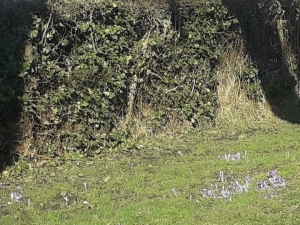
Crocus flowers though not a native wildflower have naturalised. These early flowering plants provide a source of nectar for those insects that come out of hibernation early, such as some bumblebees and early butterflies, such as the Brimstone (Gonepteryx rhamni). Brimstones have been already observed this year, as they hibernate over winter and emerge once temperatures reach 13o C.
Lesser Celandine (Ficaria verna)
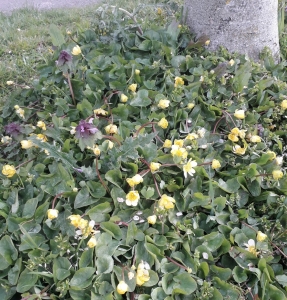
January to April. A member of the buttercup family (but please do not pick as all parts are poisonous). It is identified by its glossy heart-shaped leaves and bright yellow flowers with 8-12 petals. As the flowers age they turn white. An early flowering plant (21st of February is known as Celandine Day), it is an important source of nectar for insects coming out of hibernation. It was Wordsworth’s favourite flower as he wrote no less than three poems about it. The lesser celandine is also mentioned in The Lion, the Witch and the Wardrobe, when Aslan the lion returns as the woods turn from winter to spring, “Edmund saw the ground covered in all directions with little yellow flowers – celandines”.
Common or English Daisy (Bellis perennis)

January to December. The present name comes from the old name “Day’s eye” referring to the petals closing at night and opening in the morning to follow the sun. The plant is formed of a rosette of green, spoon-shaped and slightly hairy leaves from which projects a single flower stalk. The yellow and white flower head is made up of many tiny individual flowers.
Common Chickweed (Stellaria media)
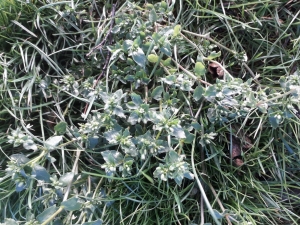
January to December. A common wildflower that flowers all year round and is therefore an important source of nectar. It gets its name as it was commonly fed to chickens and cage birds. It has five, small, white, deeply-lobed petals and its branching stems often hug the ground.
Groundsel (Senecio vulgaris)
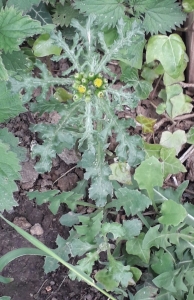
January to December. An annual plant that can be seen in flower most months of the year. The leaves are long, lobed and ragged, the lower leaves possessing stalks whilst those further up are stalkless. The stems branch, leading to open bunches of small green and yellow flower tubes. As the plant sets seed these turn to fluffy white seed heads. Senecio comes from the Latin for “old man”, and if you remove the seeds from the flower you will discover a dotted, bare, “scalp”. It is considered a good food source for several caterpillars and is one of only two plants for the caterpillar of the Cinnabar Moth.
Flowers from March
Bulbous Buttercup (Ranunculus bulbosus)
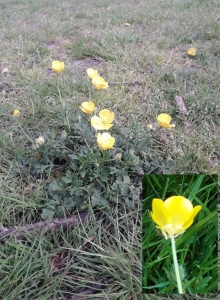
March to May. This plant has bright-yellow flowers, a hairy grooved flower stem, a bulb-like swelling at the base of the plant and down-turned sepals beneath the petals (see insert). The name buttercup is thought to have come from the mistaken belief that they gave the yellow colour to butter. In fact, they are poisonous to cattle when green, (though safe when dried in hay), and are frequently avoided by grazing animals.
Green Alkanet (Pentaglottis sempervirens)

March to July. This plant is also known as Evergreen Bugloss and is a hairy perennial plant with a basal rosette of oval leaves with a flower stalk supporting many bright blue flowers. Originally from South West Europe, it was introduced sometime before 1700. It is a flower much loved by a wide variety of pollinators.
Dandelion (Taraxacum officinale)
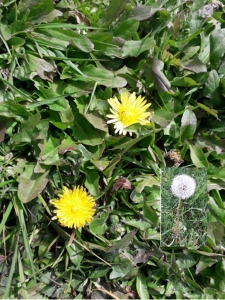
March to October. Probably the most easily recognised wild-flower with its bright-yellow flowers and round, white seed “clocks”. The dandelion is a collection of microspecies. In areas where grass is kept short, it forms with short flower stalks, while in tall vegetation the long-stemmed forms flourish. The name comes from the French “Dent de Lion” which refers to the toothed shape of the leaves. Dandelions are one of the few flowering plants that reproduce mainly asexually, the seeds being clones of the mother plant. All parts of the plant are edible.
Red/Purple Dead Nettle (Lamium purpureum)
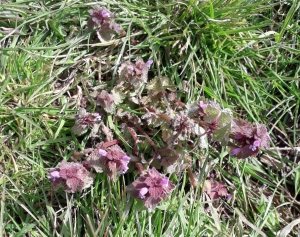
March to November. This plant looks similar to the stinging nettle but it is not related. Red dead-nettle has heart-shaped, toothed, aromatic leaves and reddish square stems which are covered in downy non-stinging hairs. There are dense whorls of pink-purple-red ‘hooded’ flowers up the stem. Even the pollen of this plant has a reddish tint and can often be seen on the bodies of bees visiting the flowers. The upper leaves also frequently take on a reddish tint making the plant very distinctive amid the surrounding vegetation.
Insects that use the plant include bumblebees and the red mason bees that visit for nectar, while the caterpillars of the White Ermine, Garden Tiger and Angle Shades moths feed on its leaves.
Flowers from April
Hybrid Bluebell (Hyacinthoides x massartiana)

April to May. This is a cross between our native bluebell and the introduced Spanish bluebell. It can be identified by its upright flower stalk and the larger more open bell-like flowers that are arranged all around the stalk. Flowers on the native bluebell hang down from one side of the stalk, are a deeper blue and are a thinner tube-like flower. Though not what we might have hoped for, this flower has appeared for the first time in nearly twenty years and may give an indication of other plant surprises to come as the wildflower strips develop.
Lords and Ladies (Arum maculatum)
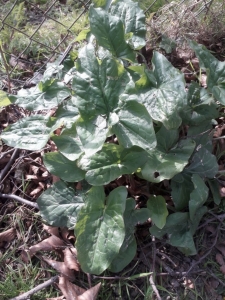
April to May. An early flowering, shade loving plant of hedgerow and woodlands. It has large arrow-shaped leaves. The leaf-like flower head curls around an inner spike of tiny, yellow flowers that give off a scent attractive to flies, the main pollinators. The unusual shape has given rise to a wide variety of common names including, Cuckoo-pint, Jack-in-the Pulpit and the lengthy ‘Kitty-come-down-the-lane-jump-up-and-kiss-me’ (an old Kentish name).
Common Mouse-Ear (Cerastium fontanum)

April to June. This is a species of chickweed and gets its name from the leaves which are covered in many fine hairs. The flowers are small and white and have five deeply lobed petals that gives them a star like appearance when open. Seeds from this plant have survived for over 40 years in the soil.
Cow Parsley (Anthriscus sylvestris)
April to June. Part of the carrot and celery family, Cow parsley has tall hollow stems surmounted by large, flat umbrellas of small, white flowers. The leaves are large and fern-like and when crushed produce a strong aniseed scent. The earliest flowering and most abundant of the umbellifers.
Please Note. This plant should not be confused with Hemlock which has similar leaves but has a purple spotted stem and should not be touched as it is poisonous. Hemlock will be removed should it be found in the wildflower strips on the Recreation Ground.
Common Dog-violet (Viola riviniana)


April to June. Dog-violets provide nectar for early insects and act as a food plant for several rare butterfly species including: Silver-washed Fritillary Butterfly (Argynnis paphia), Dark Green Fritillary (Speyeria aglaja ), and Small pearl-bordered Fritillary (Boloria selene).
Germander speedwell (Veronica chamaedrys)

April to June. This plant is one of several speedwells found in the UK. It is readily identified by the two rows of long white hairs growing up the stem. The flowers are a bright blue with a white centre that give rise to the other name by which it is known “Bird’s-eye Speedwell”.
Meadow Buttercup (Ranunculus acris)
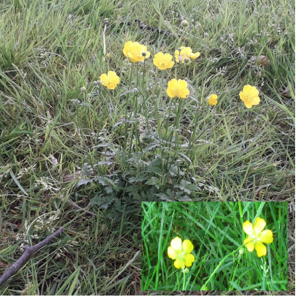
April to October. The second of the three buttercup species we might hope to find on the Recreation Ground, the Meadow Buttercup can grow to 60cm and the flowers are found in open clusters at the top of a branching stem that does not have grooves along its length unlike the other buttercups. Possibly easy to confuse with the Bulbous Buttercup, it can be identified by turning the flower upside down and the green sepals on the meadow buttercup support the petals whilst the sepals on the bulbous buttercup are curled back against the stem.
Ribwort Plantain (Plantago lanceolata)

April and continues until the frosts. From a rosette of spear-shaped leaves, the short, oval, flower heads rise, balanced on the top of thin, wiry stems. From the tight flower heads, white stamens project and the flower heads slowly turn brown as the seeds develop. These seed heads last for most of the winter and provide a food source for seed-eating birds such as goldfinches.
Flowers from May
Alexanders (Smyrnium olusatrum)

May to June. This plant was introduced to Britain by the Romans who called it “the pot herb of Alexandria” as all parts of the plant are edible and there are many recipes on the internet describing various cooking methods. Now considered naturalised, it is an important early source of nectar for insects, though it needs to be managed, as if uncontrolled, it can quickly smother other vegetation.
Smooth Sow Thistle (Sonchus oleraceus)
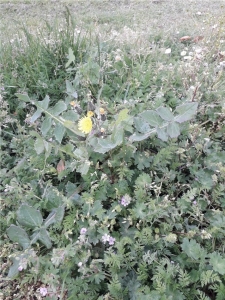
May to June. The leaves of this plant are often deeply-lobed with a triangular tip and early plants may be mistaken for dandelions. When broken, the leaves exude a white latex-like sap. The yellow dandelion-like flowers are found in a loose bunch at the top of a hollow stem. It gets its name, Sow Thistle, as the milky-white sap was thought to help milk production in mothering pigs.
Stinging Nettles (Urtica dioica)
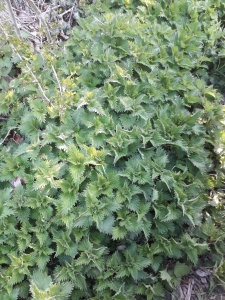
May to September. Thought to have been introduced by the Romans, and though often disliked by gardeners, this plant supports over 40 species of insects. They in turn are fed upon by other species such as ladybirds and small insect-eating birds such as Blue Tits. The large seed crops are also beneficial to seed-eating birds. Caterpillars of the Small Tortoiseshell, Red Admiral, Peacock, Comma and Painted Lady, all feed on stinging nettles and may overwinter as chrysalids in the leaves.
Fairy Flax (Linum catharticum)

May to September. A delicate plant growing up to 30cm tall. It has long slender branched stems from which the narrow leaves appear in pairs. The small, white, five-petalled flowers bloom at the end of the stems and droop when in bud. Fairy flax was also known as ‘Purging flax’ and was traditionally used as a laxative by herbalists.
Shepherds Purse (Capsella bursa-pastoris)

May to October. This plant has small, heart-shaped seed cases from which it gets its name, as they are considered similar in shape to the purses used by medieval shepherds to carry their food. The flowers are small, white and scentless. The seeds have an unusual property in that they both attract, and kill worms, and thus locally fertilise the soil
Hedge Mustard (Sisymbrium officinale)
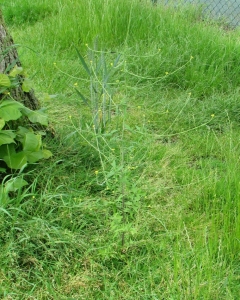
May to October. In June 2021, there was only one plant on the Recreation Ground, by the tennis courts. A large, open, candelabra-like plant, it has small yellow leaves on tough, twisted, wiry stems that appear from May to October. The lower leaves are deeply pinnately, lobed with a large terminal lobe forming a rosette. Upper leaves are narrower and close to the stem. It is the food plant for the caterpillars of the Green-veined White and Orange Tip butterflies.
White Clover (Trifolium repens)

May to October. A low-growing, creeping plant often forming dense mats. The leaves are comprised of three rounded leaflets often bearing white markings. The white or pinkish flowers are borne on round heads on a bare flower stem. It is a foodplant of the Common Blue Butterfly and the flowers are attractive to many kinds of bumble bee as well as honey bees. The plant has nitrogen fixing nodules on its roots and is an important plant for increasing fertility in soils.
Flowers from June
Cleavers
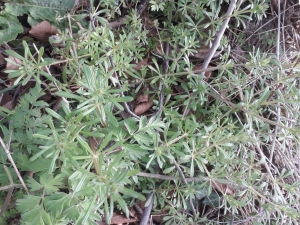
June to August. Also commonly known as goose-grass, as it was fed to geese and ducks, it is readily identifiable by the numerous hooked hairs on the leaves, stem and seed cases. Cleavers consist of a square or angular stem with whorls of 6-8 thin leaves at regular intervals. The flowers are small, white and inconspicuous.
Cat’s-ear (Hypochaeris radicata)

June to September. Often confused with dandelions, the main distinguishing features of Cat’s-ear are the lobed and hairy leaves forming a basal rosette around a central taproot. The stems that are forked and solid, unlike the single hollow stem of a dandelion, support bright yellow flowerheads that are flatter in appearance. It gets its name from the shape and fine hairs on the leaves which are thought to resemble a cats ear. The root can be roasted and ground to form a coffee substitute.
Bramble (Rubus fruticosus)
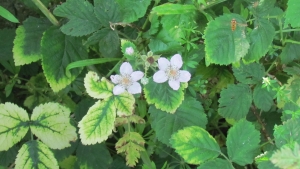
June to September. The Bramble or Blackberry has long, arching and thorny stems. The leaves are arranged alternately and comprise 3-5 short-stalked, serrated leaflets. Flowers are white or pink and appear in clusters from late spring. The leaves are food for caterpillars of Green Hairstreak, Grizzled Skipper, Holly Blue and Speckled Wood butterflies. It also provides habitat and food from its berries for a wide variety of wildlife including birds, small mammals and even Grass-snakes.
Common Mallow (Malva neglecta)
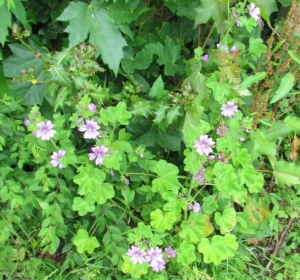
June to October. Common mallow is a large, spreading plant with 5 petalled, mauve and deep purple striped flowers. The seed pods are said to resemble pork pies. Certain parts of Common mallow are edible (leaves, flowers and seeds). Probably introduced by the Romans who cultivated it for food and medicine. It is a foodplant of the Painted Lady caterpillars.
Creeping Thistle (Cirsium arvense)

June to October. The most common species of thistle found on a wide variety soil types. It can rapidly cover large areas of ground via its extensive creeping roots. The flowers consist of multiple lilac-pink florets that produce multiple, fluffy seeds and is an important food source for many seed-eating birds.