
**The next Beating the Bounds will take place in September/October 2026**
A tradition that has been kept alive in Ash every five years by the parish council. ‘Beating the Bounds’ is the walking of the boundary of the parish. In the past, this was done by ecclesiastical parishes to check the boundaries had not been moved. Although modern surveying techniques have made the traditional purpose obsolete, Beating the Bounds is continued as a way of giving the community a sense of place. In Ash, part of the tradition is to ‘bump’ the youngest participants on the boundary stone at Pluck’s Gutter, if the vicar is not present.
The boundary of Ash is about 19 miles long and several miles are formed by the River Stour. This part is usually done by boat, although until 2021 there were always some who walked the entire distance. The complete walk takes about 10 hours.
Saturday 9th October 2021
Thank you to Kevin Ellis, Graham Foat and Robert Hudson for the maps and information that guided the walk, to Jacqueline Wilkinson who led the walk, and to all the landowners who kindly agreed to the walkers crossing their land.
The photos have been provided by Jan Connor, David Goff, Christine Haggart and Andrew Harris-Rowley who also produced the video. Click on the video to load.
Setting off from Pudding Lane
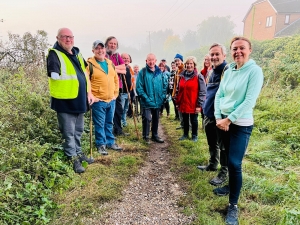
Soft, misty morning as fifteen intrepid walkers ready to set off at 7am from Pudding Lane, to Beat the Bounds of Ash Parish.
From left to right: Martin Humphries, Andrew Harris-Rowley, Andrew Wilkinson, Rev David Moulden, Jacqueline Wilkinson (just visible), Jan Connor, David Goff, Kim Humphries, Ian Salter, Becky Newing, Denise Lodge, Christine Goff, Christine Haggart, Mark Venny, Louise Venny. Photo taken by Kevin Ellis.
St Nicholas Church in the mist
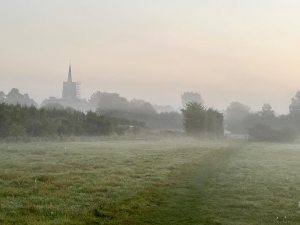
The view of St Nicholas Church is the first reminder of how the experience of generations flows into our present life.
Durlock
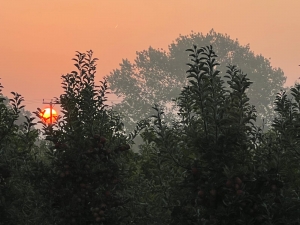
Down to the boundary with Woodnesborough Parish at Durlock, with the stream and ditches that keep the land drained and productive. The sun is an orange globe still low in the sky.
Heading to the Frog and Orange
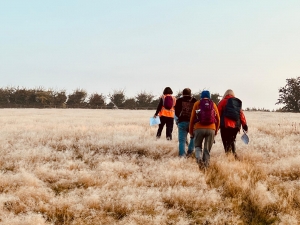
Determined and very fresh, crossing A257 by the Frog and Orange, and into the open fields. Not lost yet. But it is only 8am
North to Nash
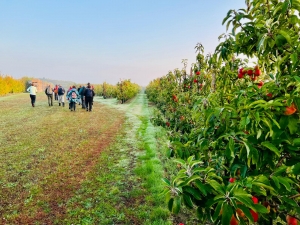
North towards Nash, through the hedged fields and apple orchards, we turn towards Hoaden.
Passing Preston
Across the open fields of recently harvested crops, and following the stream that marks the boundary with Preston Parish, the picking of the bright red Gala apples is taking place. This year, no-one has to try to navigate through the brambles, as has been done in the past, and we leave the boundary for a more sedate route to Sheerwater.
Sheerwater to Westmarsh
Continuing along the boundary, through fields of potatoes ready to be dug, two buzzards are sighted, more usual now than in the past. We follow the stream onto the Ash Levels with Westmarsh on our right. The chimney of one of our walkers can be glimpsed through the trees. Should we call in for late breakfast?
The band crosses the Stour Valley Walk at 9.30am and the first fence is crossed.
Crossing from Westmarsh
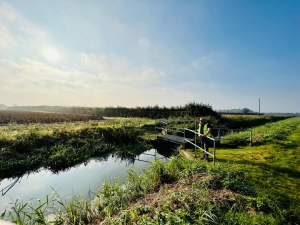
Taking a rest on the crossing over the Stourmouth Stream from Westmarsh. No we are not lost, but our sweeper took a break and is snapped.
Stourmouth Stream
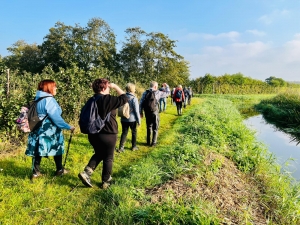
Walking on the Preston Parish side of the boundary so that no-one will have to swim across the Richborough Stream, swans are quietly photographed. In earlier days, dinghies were used to navigate the waterways that cross the boundary inside the parish.
Swans Gliding Past
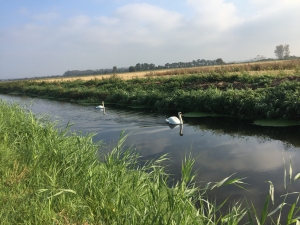
Along the Stourmouth Stream, are a pair of very photogenic swans. On the way to the Levels, heron and two buzzards were also glimpsed.
Dog and Duck at Plucks Gutter
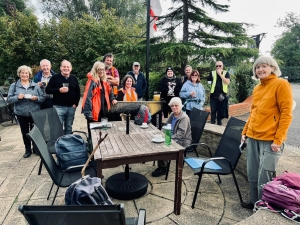
By quarter to eleven, we arrive at Plucks Gutter. Much earlier than anticipated and before the Dog & Duck opens. Clearly we had to rest until opening time.
Bumping the Vicar
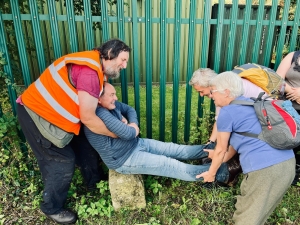
The vicar kindly consents to being bumped on the boundary stone. The youngest member of the group is very pleased that that it is the vicar today. In other years, the youngest ‘beaters’ were bumped on the boundary stones along the way, to make sure they remembered the route for when it was their turn to lead. Today we have the OS maps but tradition can be fun.
Ferry Nymph
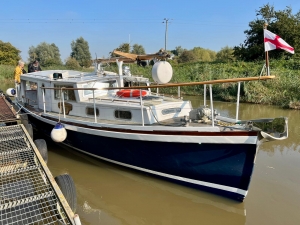
At 12.30 we board the Ferry Nymph with Captain Collin and the knowledgeable and indomitable Liz. The Ferry Nymph now lovingly restored, was one of the little ships that made the crossings to Dunkirk in 1940 to bring the soldiers back to ‘Blighty’. Along with hundreds of other ships, the Ferry Nymph made two crossings bringing hundreds of soldiers back to Dover and Ramsgate. It is both a grim and a heroic reminder of the complicated history of the East Kent Coast.
River Stour
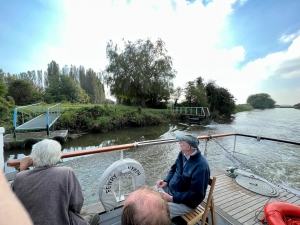
The middle of the River Stour is the boundary between Minster and Ash parishes. Sailing down the river gives a glimpse back to the days when this was a vital route for transporting goods and people inland.
Views of the Stour
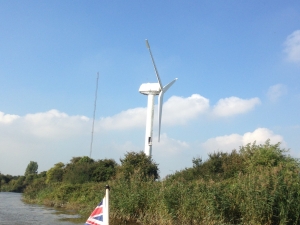
Downstream of Plucks Gutter, cows and calves grazing on the south bank of the river and views of the current industrial development on the north side, with the change from the towers of the power station to wind turbines and solar panels
WWII Prison
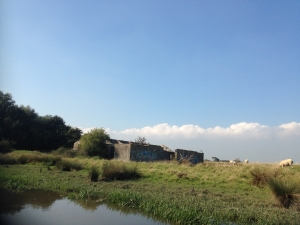
Stone prison from WWII, a reminder that the river the surrounding area was used during the war for many different purposes.
Richborough to the Sandwich Sluice
Not in Sandwich but in the parish of Ash, the Richborough Roman Fort and the surrounding area, is an important part of both the history of the parish and the growing tourism that economically benefits the parish. Disembarking at 1.30pm, the walk along the riverside highlights the change in boats moored and the recent array of small gardens, sheds and parking areas feel very ‘urban’. It is no longer possible to keep to the boundary at North Poulders, as it is unsafe to cross the A256. However the diversion was too diverting, as we missed the Sandwich sluice completely, going straight on the Richborough Road and heading north rather than south.
Cattle Drive
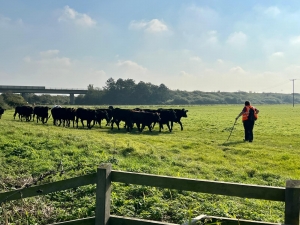
The Richborough diversion leads to an engaging meeting with a small herd of young bullocks. Very curious or just needing some entertainment, these young cattle are kept at bay while the field is crossed. Two other intrepid cowhands join the main man. With cattle at their heels, the cowhands join the rest of us, safely behind the gate.
North Poulders Stream
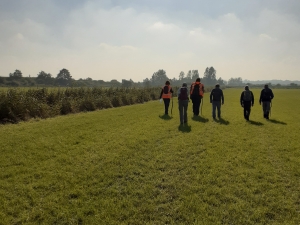
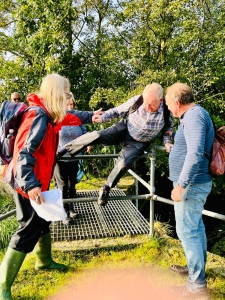
Back on the boundary at the North Poulders Stream, the border with Woodnesborough Parish, the sun is now high in the sky and it feels quite summery. A series of gates leads to some acrobatic moves but no damage to gates or climbers.
East Street
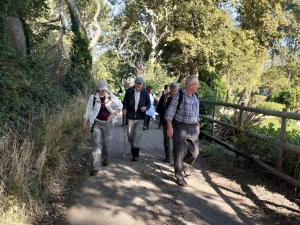
Walking along East Street, the trees are providing welcome shade. Following the by-way, now tarmacked to the A257, feels very different to the open fields that we have just walked. The pace has slowed and it is quarter to three by the time we reach Each End.
Each Manor Farm
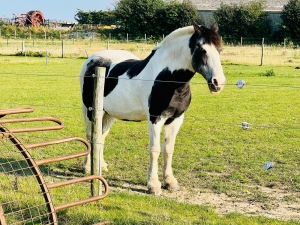
Still bordering Woodnesbourgh, and coming along to Each Manor Farm, we see a young lady practicing her very professional dressage skills. There are horse paddocks either side leading into a farm yard where the people working with the horses are very surprised to see us. All sorted, as yes we had spoken to the owner beforehand.
Marshborough
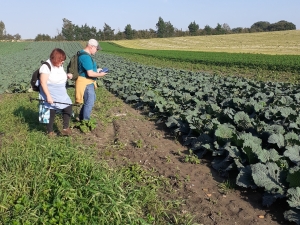
Another diversion off the Marshborough Road is needed, as the boundary along New Street goes between Vine Cottage and a new home being built. No longer possible to walk in the front door and out the back.
Coombe Lane
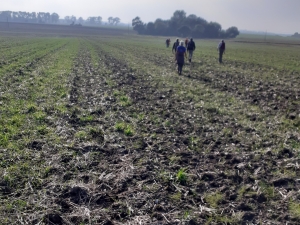
Emerging onto Coombe Lane and crossing into the open fields south of the parish, the view to Woodnesborough and across to Staple is noteworthy. The church spire is in clear view but there are still ditches to navigate and open fields to walk. The legs are feeling very heavy. Yes, there are some detours leading to unpassable hedges. A brave two walk a fallen tree across a ditch, while the remainder trudge back along the ditch until a safer crossing is found.
Back to the Beginning
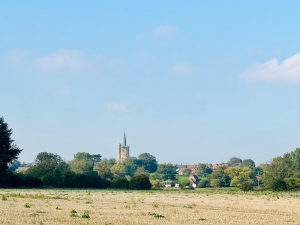
The church spire beckons us to the Jack Foat Trust Field and at 4.30pm we arrive back at our starting point. A wonderful day of walking, meeting new people, great conversation and a feeling of accomplishment. Keeping alive a tradition that stretches back many years, and today reminds us how the land in our parish is varied, beautiful and productive.